
The Evolution of Film Music: A Joyful Ride From Silent Cinema to Modern Soundtracks
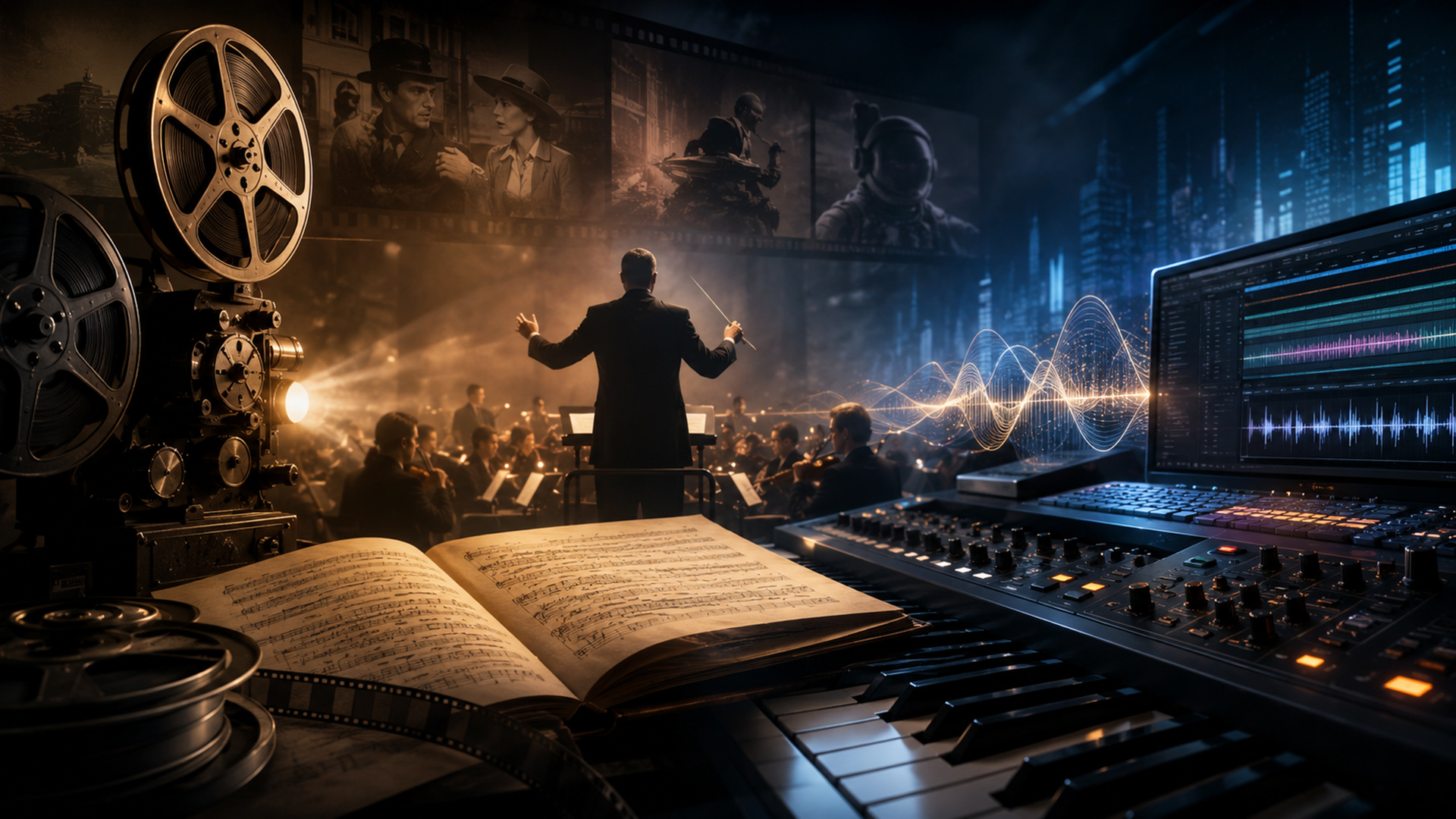
Film music is sometimes treated as an element added after a movie has already been made. In reality, it can be as important to storytelling as cinematography, acting or editing. A carefully constructed score guides the audience through the emotional world of a film, giving meaning to images that might otherwise feel neutral or ambiguous.
The evolution of film music stretches from live piano accompaniment in early cinemas to the enormous orchestral, electronic and experimental productions heard today. Along the way, composers have borrowed ideas from opera, theatre, classical music, jazz, popular music and electronic sound design.
Although musical fashions have changed, the central purpose of film music has remained remarkably consistent: to support the story, shape the atmosphere and help the audience connect emotionally with the characters.
Where Did Film Music Come From?
The earliest motion pictures did not contain recorded dialogue or synchronised sound, but the experience of watching them was rarely silent. Screenings were commonly accompanied by a pianist, organist or small musical ensemble. Larger cinemas could employ full orchestras, while smaller venues depended on whatever musicians and instruments were available.
The music might be improvised, selected from existing classical and popular pieces or arranged according to a cue sheet. These cue sheets suggested particular pieces or musical styles for moments of romance, suspense, comedy, tragedy or action. The Library of Congress preserves thousands of silent-film scores, arrangements and cue sheets created between 1904 and 1927, demonstrating how central music already was to the cinematic experience.
One important early landmark was Camille Saint-Saëns’ music for the French film The Assassination of the Duke of Guise in 1908. It is widely recognised as one of the earliest original scores written specifically for a film by a major established composer.
Film music drew heavily from forms that had already combined music with drama. Opera provided powerful examples of how recurring themes could represent characters, places, objects and ideas. This approach, closely associated with the leitmotifs of Richard Wagner’s operas, would eventually become one of the foundations of film scoring.
Theatre and ballet were equally important influences. Both demonstrated how rhythm, orchestration and musical timing could follow physical movement, reveal unspoken emotions and prepare an audience for a dramatic event.
When synchronised sound became commercially established during the late 1920s, studios could record music as part of the film itself. This made the musical experience more consistent: audiences in different cinemas could finally hear the same score rather than entirely different local accompaniments. The transition was gradual, but it permanently changed the relationship between music and the moving image.
The Golden Age and the Expansion of the Film Score
During the 1930s and 1940s, Hollywood developed the sweeping orchestral style that many people still associate with traditional film music. Several influential composers had European classical training and brought the harmonic language, orchestration and dramatic scale of late-Romantic concert music and opera into the studio system.
Max Steiner was one of the central figures in this development. His score for King Kong in 1933 closely follows the drama while using recurring musical ideas to connect characters and events. His music for Gone with the Wind later became another defining example of the large-scale Hollywood score. The Library of Congress credits Steiner with more than 300 film scores across his career.
Erich Wolfgang Korngold brought a particularly rich, melodic and operatic sound to adventure films. His famous scores include Captain Blood, The Sea Hawk and the Oscar-winning The Adventures of Robin Hood. Korngold’s energetic brass writing, lyrical themes and colourful orchestration helped establish a musical language for heroic cinema that later composers continued to develop.
Film scoring did not remain limited to romantic orchestral music. Bernard Herrmann approached cinema with a more psychological and frequently unsettling musical language. His collaborations with Alfred Hitchcock included Vertigo, North by Northwest and Psycho.
In Psycho, Herrmann’s tense string writing gives the film a nervous, claustrophobic quality. The famous violent string gestures associated with the shower scene do more than accompany the images: they make the attack feel sharper, more chaotic and more terrifying. Elsewhere in the film, the strings communicate anxiety even when nothing visibly threatening is happening.
By the 1950s and 1960s, composers increasingly incorporated jazz, popular music, unusual instruments and modern concert techniques. Electronic sound also began to find a place in cinema. Bebe and Louis Barron’s work for Forbidden Planet in 1956 is generally recognised as the first completely electronic score for a commercial feature film. Its otherworldly sounds helped make the planet feel unfamiliar, technological and genuinely alien.
Ennio Morricone later demonstrated how unconventional combinations of instruments could completely redefine a genre. His scores for Sergio Leone’s westerns, including The Good, the Bad and the Ugly and Once Upon a Time in the West, used whistles, electric guitars, voices, bells and dramatic orchestral writing. Instead of simply reproducing the familiar sound of older westerns, Morricone created a strange, spacious and instantly recognisable musical world.
His work was not limited to westerns. Films such as Cinema Paradiso and Once Upon a Time in America reveal his gift for deeply lyrical themes capable of expressing memory, regret and longing.
John Williams brought renewed attention to the grand symphonic tradition during the 1970s. The two-note shark motif in Jaws creates suspense before the shark is visible, teaching the audience to associate the music with approaching danger. In Star Wars, recurring themes give heroes, villains and ideas their own musical identities, helping an unfamiliar science-fiction universe feel emotionally clear and mythic.
Williams’ other celebrated works include E.T. the Extra-Terrestrial, the Indiana Jones films, Jurassic Park, the first three Harry Potter films and Schindler’s List. His Academy Award-winning scores include Jaws, Star Wars, E.T. and Schindler’s List, along with his adaptation work for Fiddler on the Roof.
Contemporary Film Music and Its Emotional Power
Modern film music does not follow a single dominant style. A contemporary score may feature a traditional orchestra, synthesisers, processed recordings, solo instruments, voices, percussion, regional musical traditions or sounds created specifically for the production.
Hans Zimmer has been particularly influential in popularising the combination of orchestral performance and electronic production. Scores such as The Lion King, Gladiator, Inception, Interstellar and Dune use texture, rhythm and sonic weight as strongly as melody. His music can make a scene feel physically larger, while repeated patterns and gradually expanding layers create momentum and anticipation.
Howard Shore’s music for The Lord of the Rings trilogy demonstrates how traditional thematic writing can function within modern filmmaking. Different cultures, locations, objects and relationships receive identifiable musical material. As the story develops, these ideas return in altered forms, allowing the music to reflect changes in the characters and the world around them. Shore won Academy Awards for both The Fellowship of the Ring and The Return of the King.
Contemporary composers also use smaller and more intimate musical forces. Hildur Guðnadóttir’s Oscar-winning score for Joker places the cello at the centre of the character’s emotional world. Rather than presenting the story from a safe distance, the music draws the audience into a disturbed and increasingly unstable psychological state.
Ludwig Göransson combines orchestral writing, experimental recording and culturally specific musical research. His score for Black Panther incorporated orchestral and electronic elements alongside musical influences and performers connected to African traditions. In Oppenheimer, restless violin writing, repeating figures and shifting layers help express intellectual excitement, personal anxiety and the frightening consequences of scientific discovery. Göransson won Academy Awards for both films.
The effect of film music is not merely a matter of tradition or personal opinion. Experimental research has found that changing the music beneath the same scene can alter how viewers understand a character, anticipate the plot and interpret the emotional atmosphere. In one study, melancholic and anxious scores produced significantly different reactions to an otherwise identical film scene.
Music can also reveal emotions that characters are unwilling or unable to express. It can suggest approaching danger, connect separate events, make a fictional place feel culturally distinct or transform an ordinary image into something tragic, romantic or mysterious.
Just as importantly, film music can work through contrast. Cheerful music placed against a disturbing scene may produce irony or emotional discomfort. Silence can also become powerful when a film has previously established a strong musical presence. The absence of an expected score can make an audience feel exposed, uncertain or suddenly attentive to every small sound.
The evolution of film music is therefore not a simple movement from orchestra to technology. Traditional orchestral writing remains alive, while electronics, global musical traditions, popular genres and experimental sound continue to expand the composer’s vocabulary.
From Max Steiner and Erich Wolfgang Korngold to John Williams, Hans Zimmer, Hildur Guðnadóttir and Ludwig Göransson, the most highly regarded film composers share an ability to understand drama. Their music does not merely tell audiences what to feel. At its best, it reveals emotional and narrative dimensions that the images cannot communicate alone.
That is why the greatest film scores remain memorable long after the final scene. They become inseparable from the characters, places and experiences they helped bring to life.
***
As an extra You can go back to homepage or visit the website of Pukiverse, the mobile game that I’m currently building.




Comments
This post currently has no comments.